Monday, 3 August 2015

രാമായണ മാസം Day One: ഒന്നിലധികം. എന്തിനധികം !!!!

രാമനു മുമ്പും പിമ്പുമുള്ള സൂര്യവംശ രാജാക്കന്മാർ ഒന്നിലധികം വിവാഹം കഴിക്കുകയും ഭോഗാലസന്മാരുമായിരുന്നു. ദശരഥനു തന്നെ മൂന്നു പത്നിമാരുണ്ടായിരുന്നല്ലോ - കൗസല്യയും, സുമിത്രയും, കൈകേയിയും. പട്ടമഹിഷിയുടെ പദവി ഉണ്ടെങ്കിലും അമ്മ കൌസല്യയെയും, ഗുണവതിയും സാധുശീലയും ആയ സുമിത്രയെയും അച്ഛൻ ദശരഥൻ അവഗണിക്കുന്നത് കണ്ടാണ്‌ രാമൻ വളർന്നത്. സുന്ദരിയും യുവതിയും ആയ കൈകേയി ആയിരുന്നു എന്നും ദശരഥനു പ്രിയം. പട്ടാഭിഷേകത്തിൽ നിന്നൊഴിഞ്ഞ് പതിനാലു കൊല്ലം രാമന് വനവാസം വേണ്ടി വന്നതിന്‌ കാരണവും കൈകേയി തന്നെ. അപ്പോൾ സ്വാനുഭവംവച്ചാണ് രാമൻ ഏകപത്നീവ്രതം നിഷ്ഠയോടെ പരിപാലിക്കാനുറച്ചത്.
പക്ഷെ രാമനിലുള്ള ബുദ്ധിയും, കഴിവും, സൗന്ദര്യവും, സൽസ്വഭാവവും ശൂർപണഖയെ മാത്രമല്ല ആകർഷിച്ചത്. ഒരുപാട് പേര് രാമനെ ഭർത്താവായി കിട്ടാൻ ആഗ്രഹിച്ച് സമീപിച്ചു. എല്ലാവരോടും അടുത്ത ജന്മം കൃഷ്ണനായി അവതരിക്കുമ്പോൾ സ്വീകരിക്കാം എന്ന് പറഞ്ഞു പിരിഞ്ഞു.
രാമായണവും മഹാഭാരതവും തമ്മില്ലുള്ള INTERCONNECTION ഇവിടെ നമ്മൾ തിരിച്ചറിയുന്നു. പത്നിമാർ കൂടുതൽ ആയാലുള്ള ധർമ്മസങ്കടം രാമനറിഞ്ഞു. പിന്നീട്, ഒന്നായതും !
© RISHIKESH KB

FEATURED FACULTY – INTERVIEW: PART I (http://researchblog.iimk.ac.in/?p=481)

Rishikesh KB of the Research Office caught up with Prof Sidhartha Padhi and Prof Arqum Mateen who spoke about their research insights and experiences.
  • First of all let me congratulate both of you for your top rated publications this year. Prof Padhi, heartiest congratulations to you for publishing in an A* category journal viz. Decision Sciences and an A category journal viz. International Journal of Production Research. Prof Mateen, heartiest congratulations to you for publishing in an A* category journal viz. Decision Support Systems and two A category journals viz. International Journal of Production Research and Marketing Intelligence and Planning.
Sidhartha S. Padhi:  Let me first thank for this opportunity and initiative.  Being an operations guy, I believe in the concept of K.I.S.S – Keep It Simple and Straight.  So you could expect my answers to be precise.
Arqum Mateen: Thanks a lot for your kind words.
  • I would like to begin by asking you what experiences have you had during your academic period that created an interest towards research? Could you throw some light on your personal journey towards research in operations management?
Sidhartha S. Padhi:  It is said that growth in science is not due to followers, but distracters. So in research we need to challenge and question conventional assumptions and theories.  Because in OM, all models are wrong as they are time and situation specific, and therefore there is a huge potential for research.  But for me primarily, it has been my association with research guide that sprouted a deep rooted interest in research.  The influence and mentoring of my supervisor has been very crucial in delving deep and exploring topics relevant and researchable.
Arqum Mateen: I come from a family of teachers, and academic environment was there since early childhood.  So I always admired and was passionate towards this profession of teaching. My interest in management in general and operations management in particular first germinated when I took courses on Industrial Engineering, Quality Management, Experimental Methods, Optimization, Managerial Economics, Psychology etc. during B.Tech. Most of the teachers were extremely well-versed in their respective subjects and some also provided multi-disciplinary integrated inputs which only served to broaden the scope of our learning. Later, the multi-disciplinary pattern of learning during my PGDM and FPM reinforced my learning and provided novel and intellectually stimulating perspectives.  My experiences there made me explore more and more areas of research interest.  And thus, my search began.
  • Describe your typical research process. How do you find / discover a research a topic?
Sidhartha S. Padhi:  If I know the outcome of research, there is no point doing research.  So there are two approaches I follow in identifying research problems. One is through identifying a real life problem leading to theory development.  For example inventory control, auction designs…etc. Two, theoretical problems developed in to cases to establish a grounded theory. It’s a backward integration of a theory.  But in both, the major issue is to find a genuine problem. So in short most of my research ideas are churned through broad reading, and rigorous self exploration. Ideas generated through research magazines and journals, textbook references, listening to video lectures of MIT Sloan and Ivy league universities, and exploring the huge database resources like proquest, science direct, Springer, Emerald…etc has also been of great use.  Another easier way I found to identify problems is to be a part of review committees.  I stand in the review boards of close to 35 Journals across the globe, and benefit from each paper I review. I could learn, relearn or unlearn something anew.
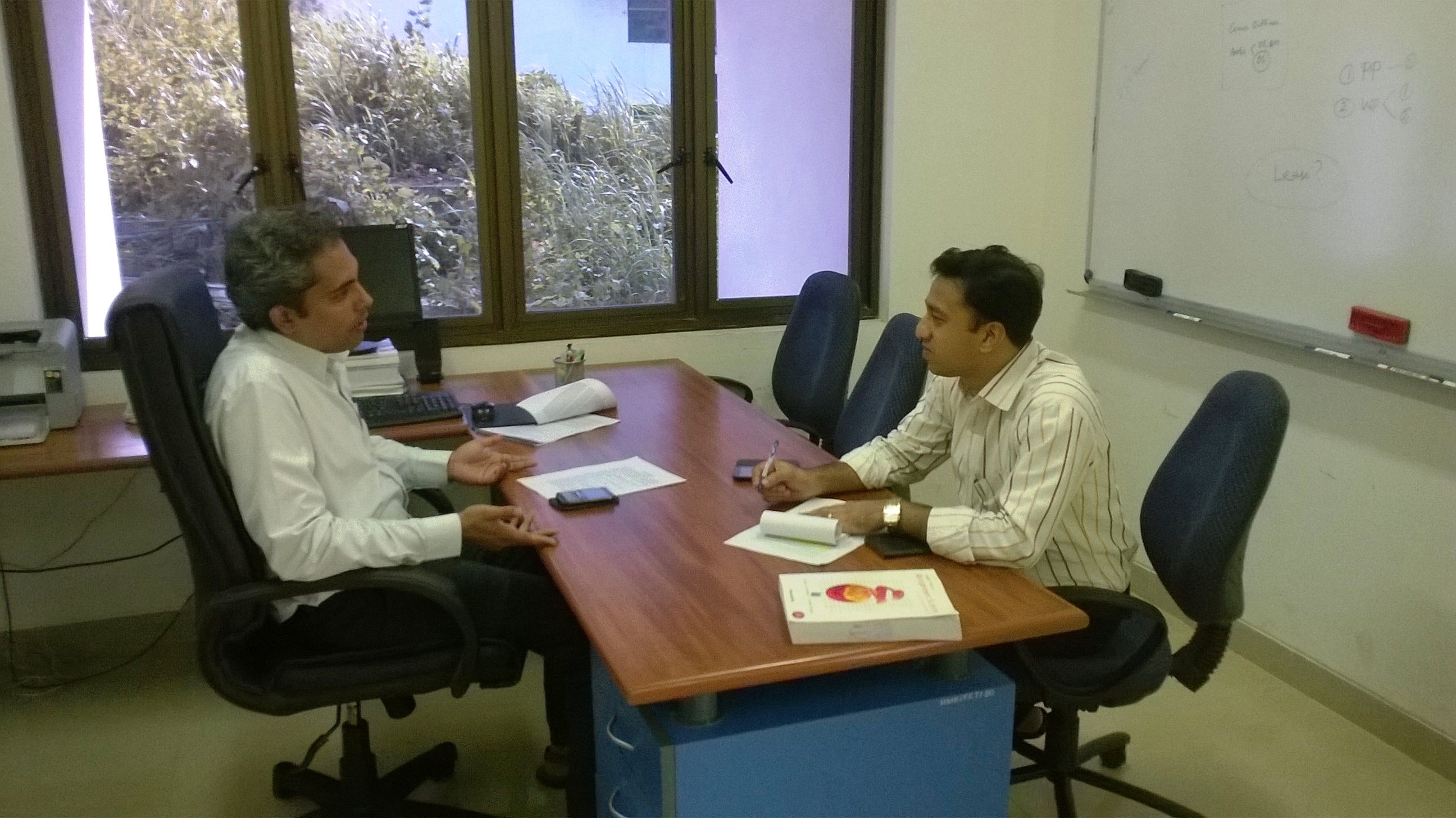
WP_20150706_007
Prof. Arqum Mateen interviewed by Rishikesh KB (Sr. Research & Publications Associate, IIMK)
Arqum Mateen:  There are primarily two paths that I follow.  One is, of course, based on extensions of published work. We try to keep ourselves up to date by reading latest issues and forthcoming articles in various journals. Sometimes, it so happens that that I get an idea about some extension or modification to those papers and then take it from there. The other emanates from my general reading of popular and business publications. Thus, sometimes when I read an article, I get some ideas to carry out some research. Of course, in this latter instance, it often happens that after getting an idea when I start searching for academic publications related to that topic, I realize that quite a bit of work has already been done. Nevertheless, it serves as a useful opportunity to learn something new, and one never knows when that might come in handy.  There are two other ways which have been useful for me. Discussions and interactions with a network of a very dynamic peer group and erudite faculty which evolved over a period of years still continue to be a major source of inspiration. In fact the idea of my first research paper evolved over a tea discussion with a batch mate. Secondly, social media resources are also becoming more and more useful to me in staying abreast of developments in the field. Thus, many people I follow on Twitter have been quite useful in providing frequent and timely updates in various academic fields. Similarly, blogs by eminent faculty in several B-schools like Harvard, Kellogg, Insead etc. are also quite useful. All these also help in my teaching
  • How would you explain the broader significance of your research to an educated layperson who doesn’t have the domain specific knowledge or the subject expertise?
Sidhartha S. Padhi:  We at IIM’s make our FPM students sit in PGP classes for the first year. And this is to gain basic management awareness, and to learn the interconnectedness of various disciplines. Similarly to appreciate its contribution, OM is one discipline which needs understanding of several other disciplines.  So I personally feel that to know about OM, one also needs to know other disciplines.  One needs to know the theory behind it, so as to appreciate its practicality.  Or else OM is just another Greek or Roman.
Arqum Mateen:  I believe research in OM is most commonly linked to what a common man experiences.  For example in inventory or logistics management, often the concern is to make the process effective and efficient. So right from the entry level to end processing or final delivery, economizing the use of resources becomes the focus. This brings in direct effects on the functioning of an organization both at micro and macro levels, and at times almost instantaneously. Thus, benefits of OM research and improvements are often quite direct and immediate.
  • Tell us in brief about your current research work.
Sidhartha S. Padhi:  I presently work on the factors that lead to the long-term survival of elite firms, which is theoretically known as the Matthew Effect or the Accumulated Advantage – For to all those who have, more will be given, and they will have an abundance; for those who have nothing, even what they have will be taken away. In other words, it’s about how the rich get richer and the poor get poorer.
Arqum Mateen: We are currently working on a couple of projects. For example, I am trying to extend my FPM work which deals with supply chain coordination through a particular mechanism called vendor managed inventory. In this we are looking at optimization of system level costs in multi party supply chains. In another ongoing project we are trying to look in to various ways through which we can enhance the effectiveness of sponsored search ads that you see when you search something on search engines like Google. We are also trying to explore how organizations can learn from firms in different industries, especially in network settings.
  • Who are the researchers in Operations Management that have inspired you?  And how
Sidhartha S. Padhi:  My inspirations were Prof. (Dr.) Pratap K. J. Mohaptra at IIT Kharagpur, and later Pof. (Dr.) Stephan M. Wagner, Professor at Swiss Federal Institute of Technology Zurich (ETH) from where I did my post doctoral. I have seen him work from 07:00am to late 02:00am, and start the day after all afresh. What else do one need as an inspiration?  Besides these the parties, New Year celebrations and the get togethers have ever been the bonding best to extend our rapport.   We call it the brown bag sessions or seminars.  The purpose is to utilize normal breaks, such as the lunch break, to provide information to attendees in a voluntary and informal setting, which is often followed by a discussion of the topic. Besides these the peer group that I had developed through networking and the selfless knowledge sharing amongst us has also enhanced the curiosity and interest in this subject.
Arqum Mateen: In addition to stalwarts in different areas of management, specifically in the area of Operations Management, I would say that I learned a great deal about teaching, research and publishing from all the Faculty members at IIM Calcutta. However, given the nature of the FPM curriculum, I was fortunate to learn from, and continue to get inspired from, teachers in a wide variety of management disciplines both here at IIM Kozhikode as well as IIM Calcutta. The list would obviously be too long, and I won’t be able to do justice to all of them.
Interviewer: That is very well said. Thank you for a wonderful session.
(Interview concludes with Part II)
as updated in IIMK research blog http://researchblog.iimk.ac.in/?p=481 as on 03-08-2015

Friday, 5 June 2015


All those whoever are truest ...............are closest of relatives

Wednesday, 3 June 2015


A KISS is a mysterious proposition. 
Its of no use to one, yet absolute bliss to two with a contraction of the mouth to an enlargement of the heart. 
A course of procedure craftily devised for the mutual stoppage of speech at a moment when words turn futile.
© RISHIKESH KB

Tuesday, 2 June 2015

വെറും പാട്ടല്ല ശാസ്ത്രീയ സംഗീതം എന്ന് എനിക്ക് ബോധ്യപ്പെടുത്തി തന്നത് 14 മെയ്‌ 2015 ന് വിട പറഞ്ഞ നെടുമങ്ങാട് ശശിധരൻ മാസ്റ്റർ ആണ്. ശാരീരവും ശരീരവും ഒരുപോലെ സംരക്ഷിക്കുകയും, അർഥവും ആത്മാവും അറിഞ്ഞ് ലയഭക്തിയോടെ പാടണം എന്നും ഓരോ പഠനത്തിലും അനുഭവപ്പെടുത്തി തന്നു. പക്ഷെ അജണ്ടകൾ ഇല്ലാതെ നിസ്വാർഥനായ് ജീവിച്ചത് കൊണ്ടും, സംഗീതഞ്യൻ എന്ന ജാട ഇല്ലാത്തത് കൊണ്ടും അദ്ദേഹത്തിലെ അറിവ് പൊതുസമൂഹം കൂടുതൽ അറിഞ്ഞില്ല, വേണ്ട വിധം അംഗീകരിച്ചില്ല എന്ന് തോന്നുന്നു. പ്രണാമം ഗുരുവേ.
© RISHIKESH KB

Monday, 1 June 2015

Teaching Methodology: The Chalk, Walk, Talk’ Days Are Gone

 Researches in education equate schools, academia and our present educational system as a byproduct of the industrial revolution offshoot of the 20th century. They critique such institutions not very different from a ‘factory’, which goes through three phases of processing.  Input (admissions), throughput (teaching-learning), and output (student pass out’s). They account the 20th century pedagogy as mere transmission of‘facts and procedures’; with the teacher being hired for ‘chalk, walk and talk’or retelling; and our student’s merit being tested through examinations of memorisation and recollection (read, remember, recollect and reproduce). This forces us to pause, ponder and pose a series of questions. The question pertinent here is: will such a teaching-learning methodology cope with the demands of the 21st century? More importantly, will the 21stcentury teacher create an impact and gain the same reverence continuing with conventional modes of teaching?

Today, what we learn, how we learn, from whom and where we learn is changing. Learning today is not just confined to the four walls of our classrooms, textbooks or the syllabus framed.  Diana Oblinger, Vice President of EDUCAUSE summarises her research that those born after 1982 have a different relationship with information and learning than their previous generations due to their access to internet and computer aided technologies. Her description of such students are known variously as ‘Net generation’ learners,  ‘Millenial students’, ‘Generation Y’ and ‘Digital Natives’.  These ‘Screenagers’ are undeniably different.  The bottom line is that these students learn and comprehend in a way that is foreign to many of us, and, as a result, they often feel disconnected from traditional teachers and schools of yesteryears. 

In today’s world, the multimedia pervades almost every part of our life.  Students live in a world of digital, audio and text.  Marc Prensky also describes the array of media the students are exposed to in his paper ‘Digital Natives’.  By the age 21, our students will have spend 10000 hours playing video games, send 200000 emails, watch 20000 hours of television, spend 10000 hours on cell phone, but less than 5000 hours reading.  It’s all electronic and digital information mediums with instant gratification. The 21st century learner is also a multi-tasker swayed by the electronic gadgets. The youth of today can instant message on their laptop, talk on a cell phone, play a video game wirelessly with a friend down the street and chew bubble gum – all at the same time. He also has multiple options of learning and looks at internet as the global source of information, especially with ‘google’ adding up a new era called the ‘AG’ – After Google! Mobile, Ipod, Social networking sites, blogs… further adds to this knowledge pool. Thus a 21st century learner has many possibilities and learning traits that conventional educators may not be familiar or comfortable with. We live in a fast-changing world wherein producing more of the same knowledge and skills will not suffice to address the challenges of our future.  The hyper-text mind of the 21st century learner faces the conventional 20th century teachers with a wealth of information and traits, mostly technological and digital.  

Though the criticism that expresses dismay on the nature of today’s student attitude towards learning stands partly valid, we cannot ignore the fact that the students of every generation sought change or maturity – intellectual, social and physical. Now, technical and technological as well. Here again, the question is, how can a teacher adapt to cope with these changes?  John Dewey, a well-known educational reformer, says it best, ‘If we teach today as we taught yesterday, we rob our children of tomorrow.’

Educational success today is no longer about reproducing content knowledge, but about extrapolating from what we know and applying that knowledge to novel situations.  With the rate of information growth continuously accelerating, we must discard the notion that a student is dependent solely on the teacher; and that the schools can teach everything every student need to know to be successful in their field of choice. Learning today must therefore play less emphasis on the amount of material memorized, but synthesize knowledge with leverage on research, questioning, making connections, thinking through issues and solving problems through collaborations with an integration of technology.  Moreover, ‘Anywhere, anytime’ learning is another catchphrase we hear often. To have anywhere anytime learning, the teacher too must be available anywhere and anytime. Its here technology yet again comes handy.

Learning is now a lifelong process of coping with change; and teaching is no longer that of dispensing facts and theories. Educational institutions of the present day have to prepare students for jobs that have not yet been created, using technologies that have not yet been invented and problems that we don’t yet know will arise. How does a teacher foster our motivated, well informed, techno savvy learners and prepare them to overcome the unforeseen challenges of tomorrow? How in this 21st century can teaching-learning be bettered? How can one be a better teacher?  I believe the ‘Learnability’ (openness and willingness to change) of both students and teachers must become the hallmark of the 21st century teaching-learning. To survive in the present environment of change, ‘learn to learn’ must become the core content of learning; wherein everyone must become partners and facilitators in the learning process.  Let each one teach one.  But a lot would depend on how a teacher generates curiosity in the minds of a learner and make the learning process more engaging and enduring. Be a transformational teacher from an instructional / informational teacher. Explore and exploit the possibilities of learning using technology. Change the ‘Chalk, Walk, Talk’ to guide our students to ‘Learn to Learn’. Change from a ‘Sage on Stage’ to a ‘Guide on Side’ – be a facilitator, a learning enabler. Redesign our ‘Marks driven’ curriculum to ‘Research driven’. Appreciate the novel 3 R’s of learning: Rigor, Relevance and Relationships with the conventional 3 R’s: Reading, Writing, Arithmetic; and above all, groom our students for their life than grooming for examinations. Let’s make our learning ‘learner centric’. Let’s forget not the life beyond the campus.  As Fredrick W Robertson observes, “Instruction ends in the school room.  Education ends only with life”. 

Today, knowledge, understanding and technology are fluid and dynamic. They evolve and change; which brings with it both challenges and opportunities. To be a better teacher, we must change and learn as our learning horizons and landscape changes. To navigate these changes and transitions, the teacher should be no different from a learner. It’s said, the highest quality of knowledge comes from teaching. I add, the highest quality of being a quality teacher is that of being a quality learner – a lifelong learner.  To quote Alvin Toffler, ‘The illiterate of the 21st century will not be those who cannot read and write, but those who cannot learn, unlearn, and relearn’.  
© RISHIKESH KB

  A menu for digital diet:   During the pandemic, one behaviour that slunk quietly into our lives is our digital addiction. Confined ind...